Table of Contents
3×3 Rubik's Cube formula
All States, Transformations and Solving Steps for the Top Face of a 3×3 Rubik’s Cube
2×2 Rubik's Cube formula
4×4 Rubik's Cube formula
5×5 Rubik's Cube formula
Rubik's Cube formula
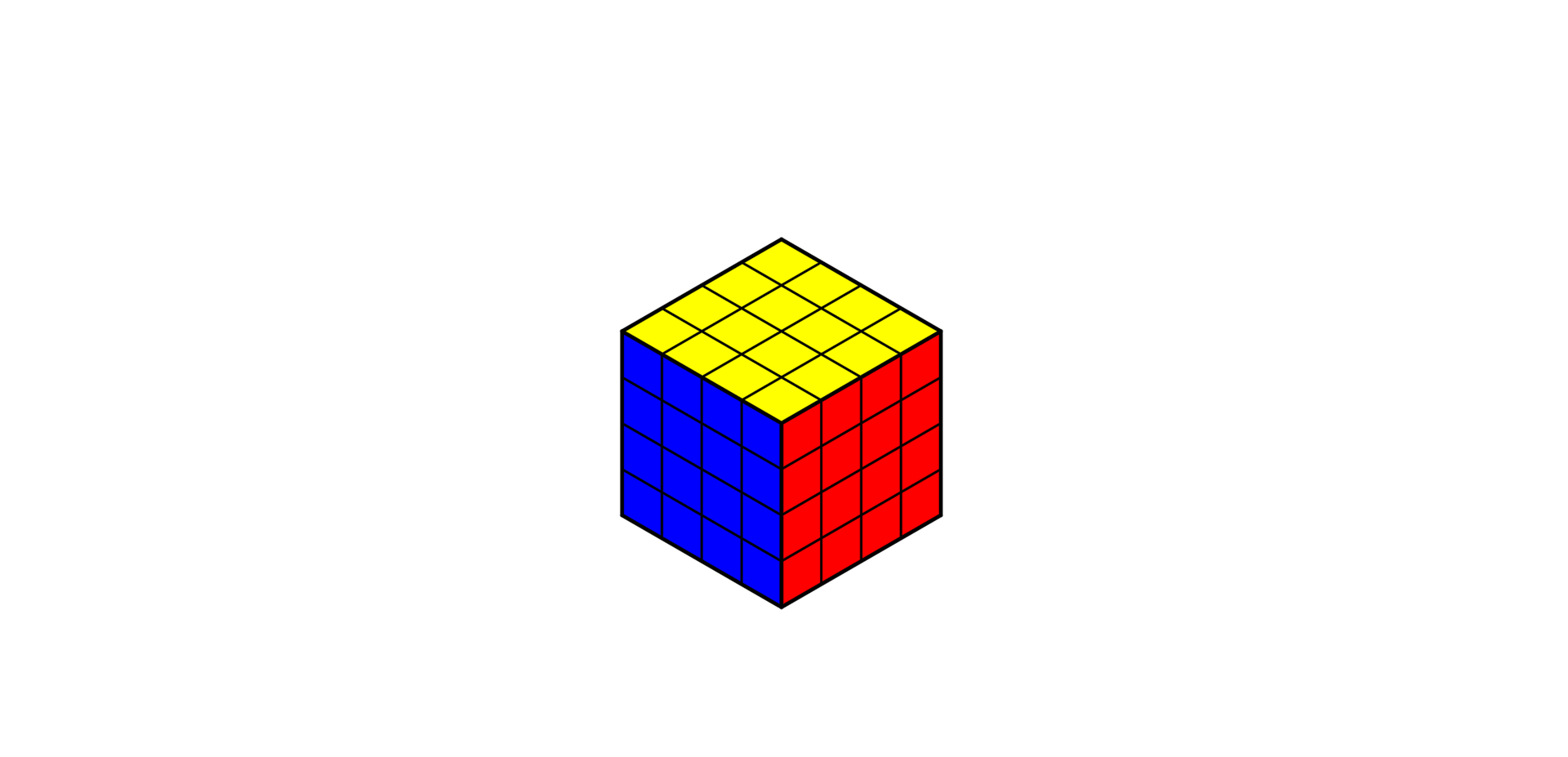
- Unlike the 3x3 cube, the 4x4 Rubik’s Cube does not have fixed center pieces. Therefore, you need to memorize the relative color positions of the six faces before solving it. The international standard color scheme is: Top = Yellow, Bottom = White, Front = Blue, Back = Green, Left = Orange, Right = Red.
1. Solve the Center Pieces ⚓︎
1.1 Solving Order ⚓︎
To avoid disrupting already solved center blocks during assembly, the recommended solving sequence for the six center sections is as follows: First solve the center blocks of the three faces adjacent to a single corner of the cube, then finish the center blocks of the remaining three faces.

1.2 Solving Steps ⚓︎
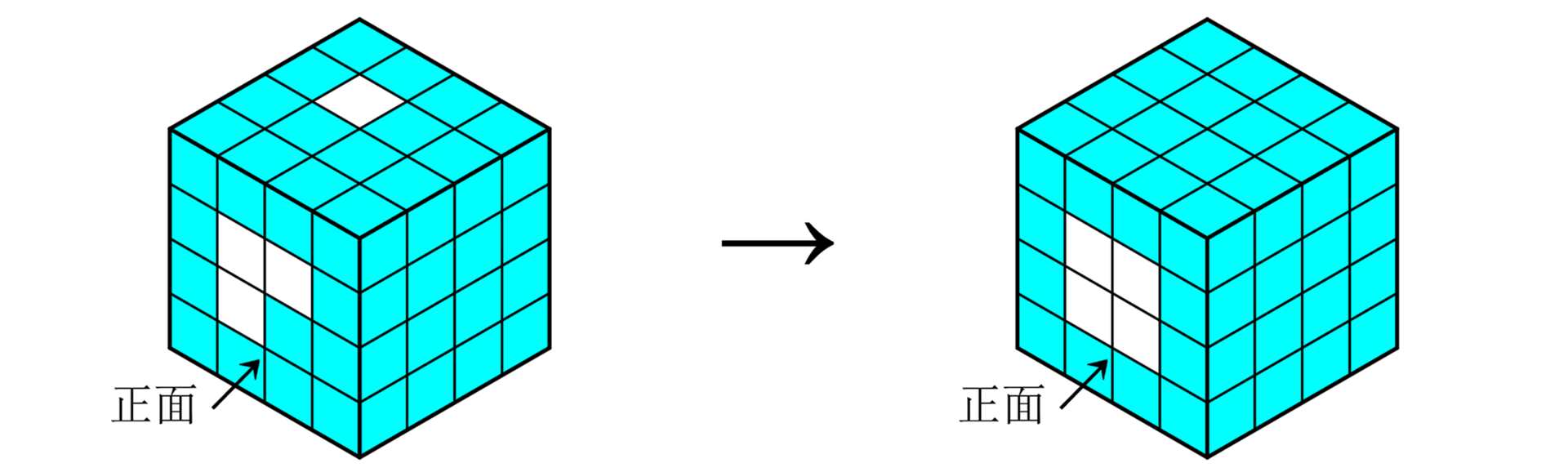
Formula 3-1: T₂R U T₂R'
Formula 3-2: T₂R U2 T₂R'
Formula 3-2: T₂R U2 T₂R'
- Solve the first three pieces of the first center block
There is no specific formula for this step. Rotate all faces and layers to solve the first three pieces of the first center block. - Solve the last piece of the first center block
- If the last piece is on an adjacent face of the first face, align the two faces to the position shown in Figure 26, then apply Formula 3-1 to complete the solve.
- If the last piece is on the back face of the first face, follow the method above and execute Formula 3-1 twice. First move the last piece from the back face to an adjacent side face, then shift it to the target first face to finish the first center block.
- Solve center blocks of all remaining faces
Solve the center blocks of other faces using the same method for the first center block. Important note: when rotating faces and layers to set up the first three pieces of any center block, ensure solved center blocks are not scrambled.
- Quick Strip Solving Method
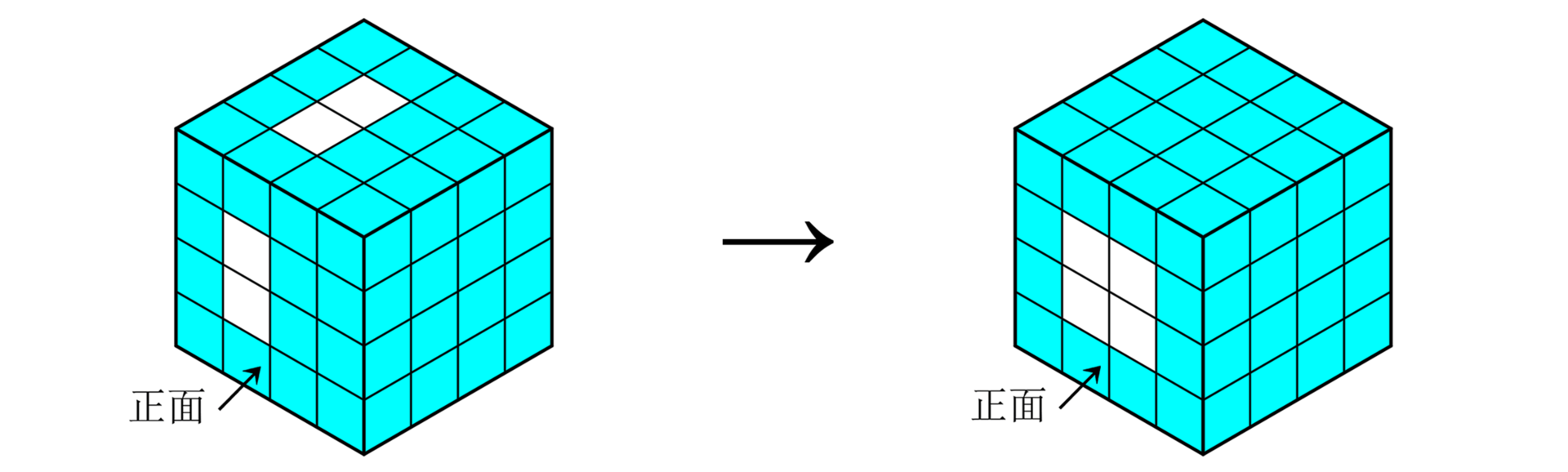
While assembling center blocks, construct two short strips first. Align the two faces to the layout shown in Figure 27, then use Formula 3-2 to combine the two short strips into a complete center block.
2. Solve Edge Pieces ⚓︎
Formula 3-3: T₂U' R F' U R' F T₂U
Formula 3-4: R F' U R' F
Formula 3-4: R F' U R' F
- First move two edge pieces of the same color to the same face (the red-blue pieces are taken as an example in the figure below).
- Case 1: The two edge pieces are on the same layer
Directly apply Formula 3-3 to join the two red-blue edge pieces together (it works no matter if the two pieces are on the upper layer or lower layer).

- Case 2: The two edge pieces are not on the same layer
After using Formula 3-4, the two edge pieces will be on the same layer, then solve them following the steps of Case 1.

3. Solve the 3×3 Rubik’s Cube ⚓︎
After solving all center blocks and edge pieces, you may proceed to solve the cube following the standard steps for solving a 3×3 Rubik’s Cube.
4. Deal with Special Cases ⚓︎
Formula 3-5: M₂R2 B2 U2 M₂L U2 M₂R' U2 M₂R U2 F2 M₂R F2 M₂L' B2 M₂R2
Formula 3-6: M₂R2 U2 M₂R2 T₂U2 M₂R2 M₂U2
Formula 3-6: M₂R2 U2 M₂R2 T₂U2 M₂R2 M₂U2
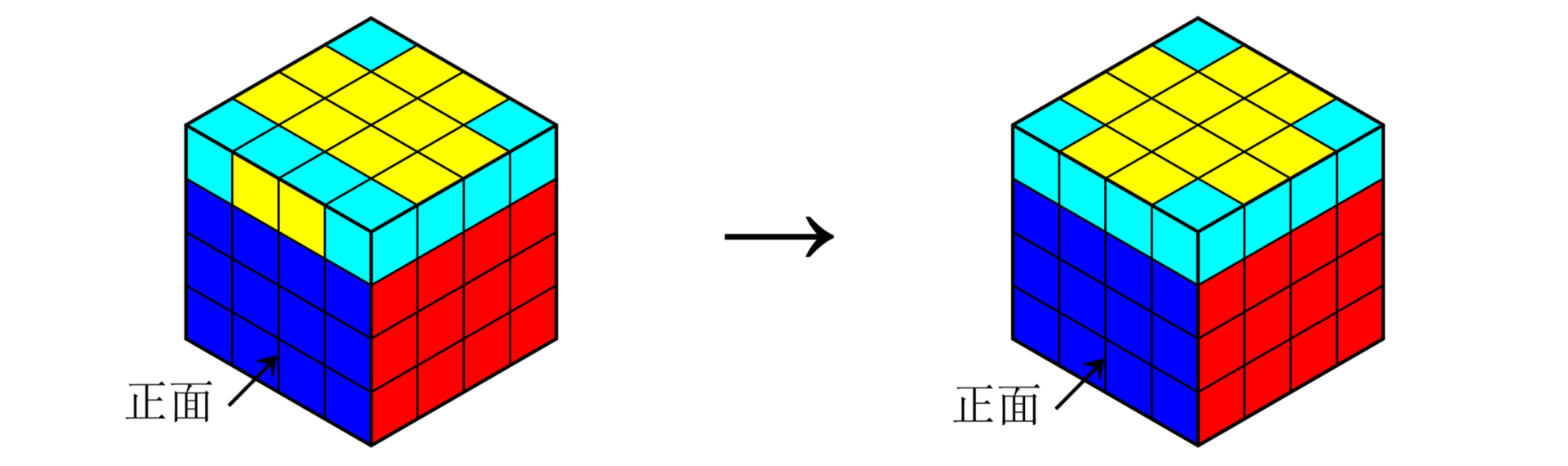
- Case 1: Edge Flip
- Occurrence Stage: Forming the top cross
- As shown below, you may fail to form the top cross while working on the top cross. Apply Formula 3-5 to flip up all yellow edge pieces.
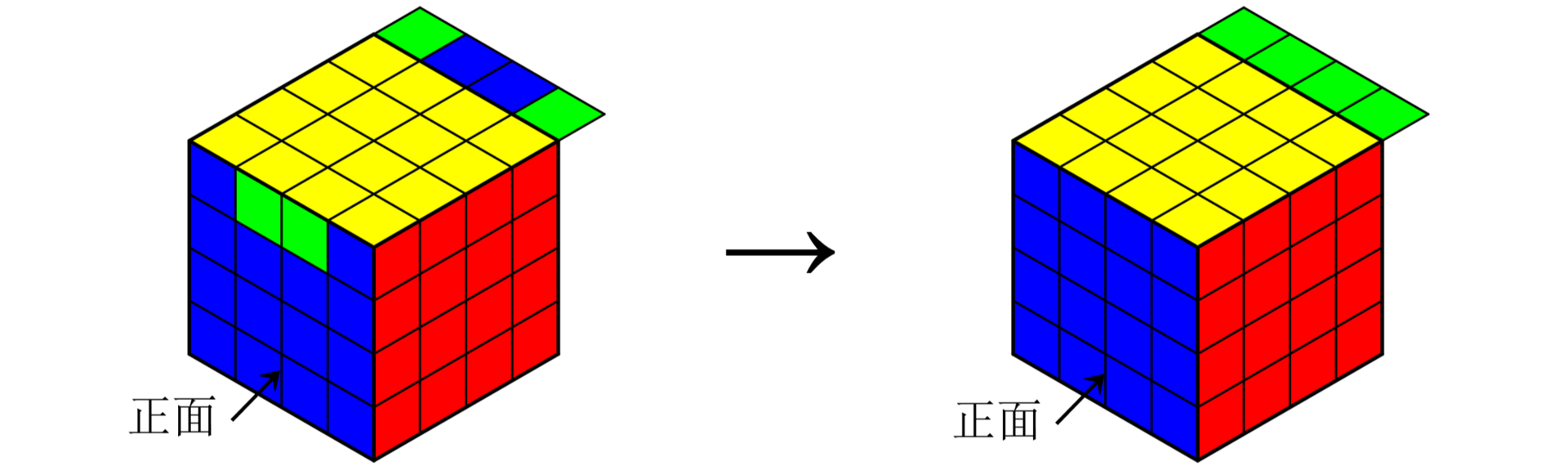
- Case 2: Opposite Edge Swap
- Occurrence Stage: Solving top layer edges
- As shown below, two side faces of the top layer may already have matching colors when solving top layer edges. Use Formula 3-6 to swap the opposite edges.
All articles on this blog are licensed under CC BY-NC-SA 4.0 unless otherwise stated.
 Wechat
 Alipay
Related Articles
2025-02-07
Rubik's Cube formula
This article includes the basic solving methods of 3x3 Rubik's Cubes, as well as the 2x2, 4x4 and 5x5 Rubik's Cubes.
2025-02-04
5×5 Rubik's Cube formula
This article mainly introduces the basic solving method for the 5×5 Rubik's Cube, which consists of two main steps: solving center pieces and solving edge pieces. After completing these steps, you can continue solving the cube following the procedures for a 3×3 Rubik's Cube.
2025-02-01
2×2 Rubik's Cube formula
This article mainly covers the basic solving method for the 2×2 Rubik's Cube, which includes two main stages: solving the bottom layer and solving the top layer.
2025-01-30
All States, Transformations and Solving Steps for the Top Face of a 3×3 Rubik’s Cube
This article mainly focuses on all possible states that may appear during the top-face solving stage of a 3×3 Rubik's Cube, along with their transformations and corresponding solving procedures.
2025-01-27
3×3 Rubik's Cube formula
This article mainly introduces the basic solving method for the 3×3 Rubik's Cube, consisting of three major stages: solving the bottom layer, solving the middle layer and solving the top layer.

2024-10-04
Hexo Tutorial (4) - Comment System
There are many plugins for the comment system, and many themes also have built-in comment system plugins. Let's take the Redefine theme as an example to introduce the usage of the Waline comment system.
Comments
Announcement
Wechat Official Account has more content!

Post Series