Table of Contents
3×3 Rubik's Cube formula
All States, Transformations and Solving Steps for the Top Face of a 3×3 Rubik’s Cube
2×2 Rubik's Cube formula
4×4 Rubik's Cube formula
5×5 Rubik's Cube formula
Rubik's Cube formula
1. Solve Center Blocks ⚓︎
1.1 Solving Order ⚓︎
- The six center blocks of a 5×5 Rubik’s Cube each consist of nine pieces. It is recommended to first form the cross of all six center blocks and then solve the corner pieces of each center block. Alternatively, you may first complete the cross on one face’s center block, solve its center corner pieces, and then tackle the center blocks of the remaining faces.
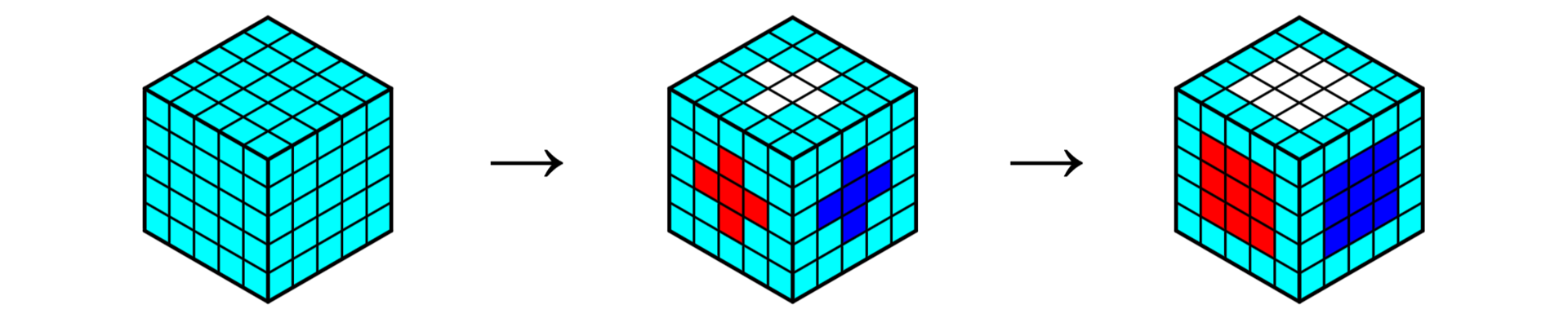
- To simplify solving and prevent scrambling already solved center blocks, the suggested solving order for the six center blocks is as follows: start by solving the center blocks of the three faces adjacent to one cube corner, then finish the center blocks of the other three faces.

1.2 Solving Steps ⚓︎
Formula 4-1: T₂R U T₂R'
Formula 4-2: T₂R U T₂R' U T₂R U2 T₂R'
Formula 4-2: T₂R U T₂R' U T₂R U2 T₂R'
- Solve the Center Cross
- Solve the first center cross: There is no dedicated formula for this step. Rotate all faces and layers to form the cross of the first center block.
- Solve the remaining center crosses: You can still rotate faces and layers to form each center cross. If this scrambles any completed crosses, position the cube as shown in Figure 34 and apply Formula 4-1.
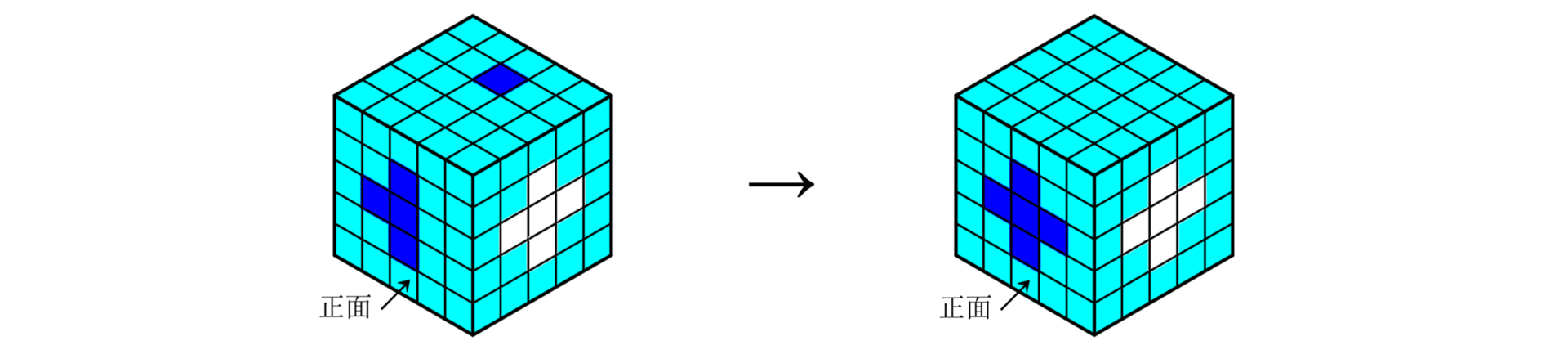
- Solve the Corner Pieces of Center Blocks
Position the cube as shown in Figure 35 and apply Formula 4-2 to solve them.
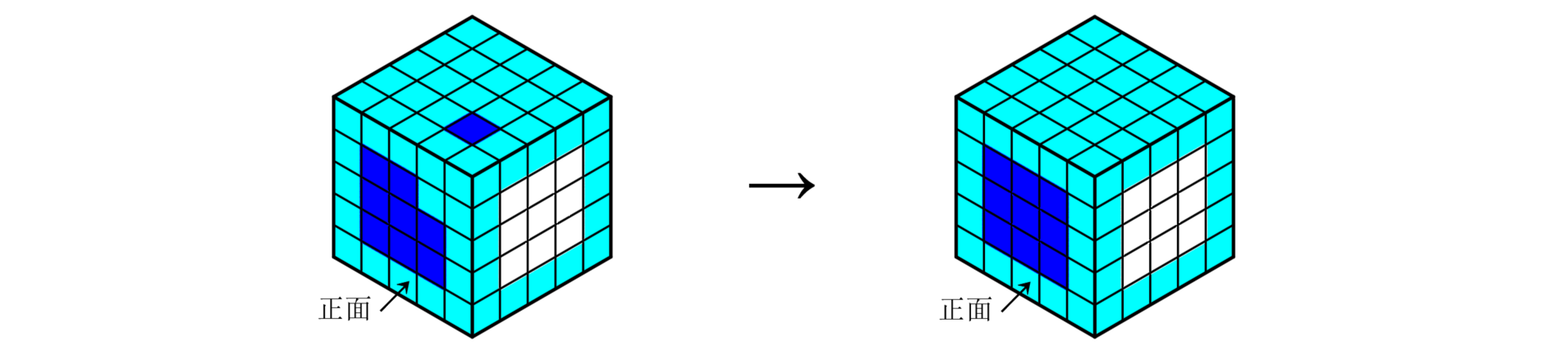
- During the above solving process, if the target cross piece or target corner piece is on the back of the working face, use Formula 4-1 to shift the target piece from the back to an adjacent face, then follow the steps above to complete the solve.
2. Solve Edge Pieces ⚓︎
2.1 Method One: Prioritize Interval Alignment ⚓︎
Formula 4-3: T₂U' R F' U R' F T₂U
Formula 4-4: R F' U R' F
Formula 4-5: T₂R2 B2 T₂R' U2 T₂R' U2 B2 T₂R' B2 T₂R B2 T₂R' B2 T₂R2
Formula 4-6: M₂R2 B2 U2 M₂L U2 M₂R' U2 M₂R U2 F2 M₂R F2 M₂L' B2 M₂R2
Formula 4-7: M₃U' R U R' F R' F' R M₃U
Formula 4-4: R F' U R' F
Formula 4-5: T₂R2 B2 T₂R' U2 T₂R' U2 B2 T₂R' B2 T₂R B2 T₂R' B2 T₂R2
Formula 4-6: M₂R2 B2 U2 M₂L U2 M₂R' U2 M₂R U2 F2 M₂R F2 M₂L' B2 M₂R2
Formula 4-7: M₃U' R U R' F R' F' R M₃U
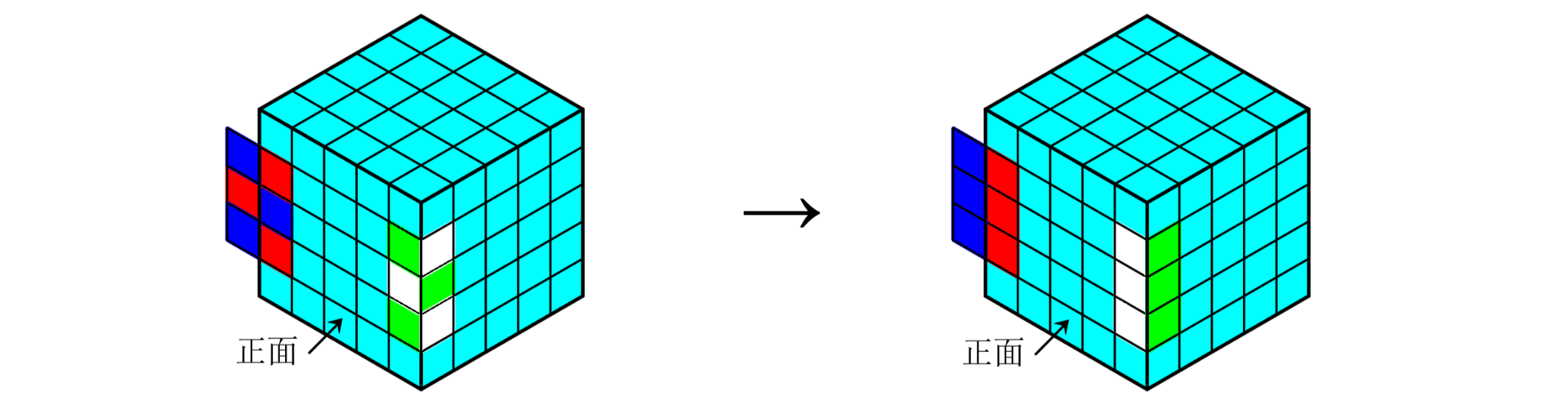
- Interval Alignment
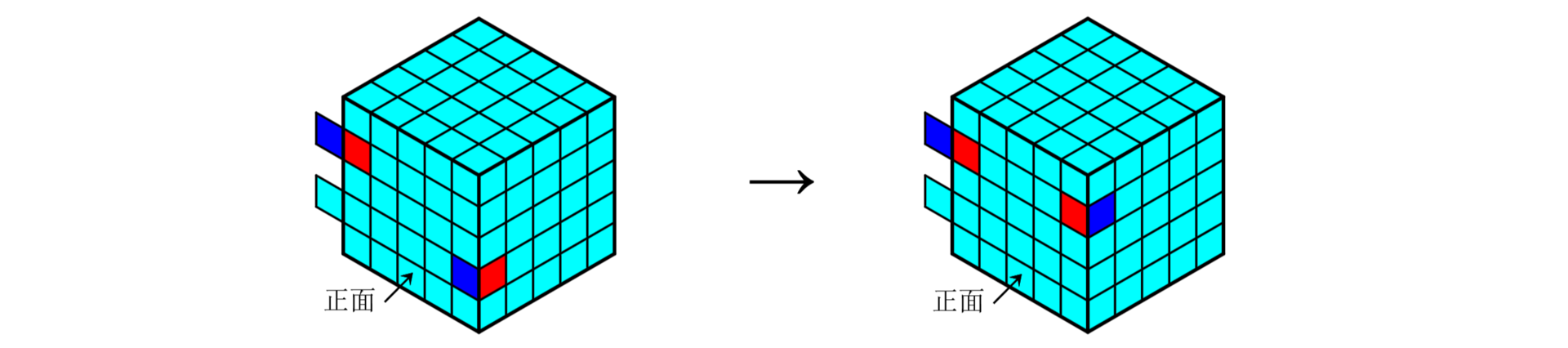
This operation follows the same steps used to solve edge pieces on a 4×4 Rubik’s Cube. First move two edge pieces of matching color onto the same face (the red-blue pieces are used as an example in the figure below). - Case 1: The two edge pieces are on the same layer
Apply Formula 4-3 to pair the two red-blue edge pieces into a complete side edge (this works whether the pieces are on the upper layer or lower layer).

- Case 2: The two edge pieces are on different layers
Apply Formula 4-4 to place the two edge pieces onto the same layer, then solve them following the procedure for Case 1.
- Solve Middle Edge Pieces
As shown below, shift the target middle edge piece and the unsolved edge piece onto the same face, then apply Formula 4-5 to complete the solve.

- Resolve Edge Flips
- Single Edge Flip
After finishing the steps for solving middle edge pieces, the scenario shown below may occur. Apply Formula 4-6 to fix it.
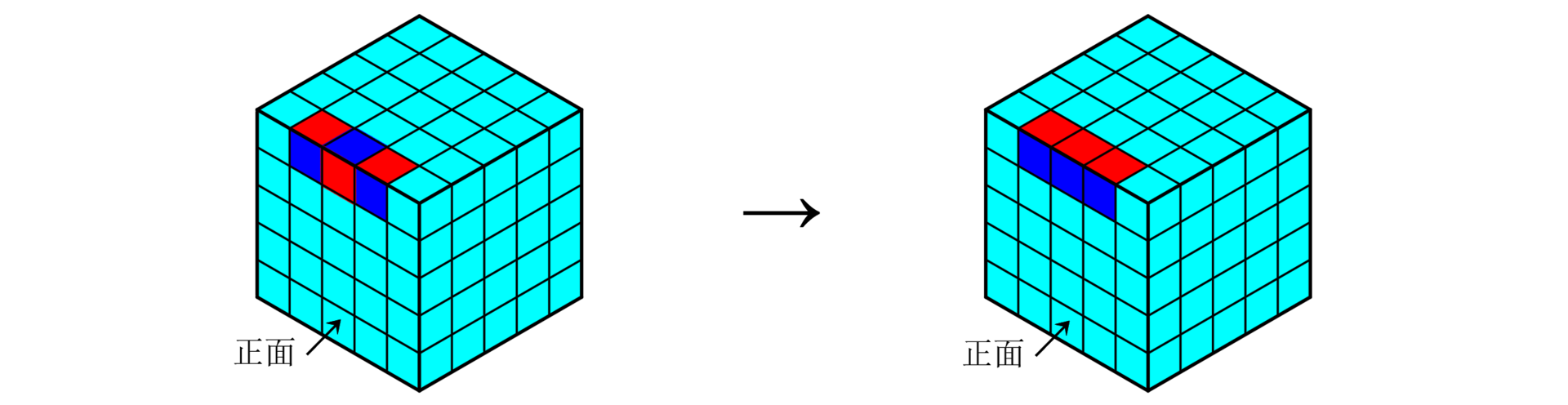
- Paired Edge Flips
If multiple edges require flipping, position two unsolved edge pieces on opposite sides of one face, then apply Formula 4-7 to solve both edges at once.
2.2 Method Two: Prioritize Adjacent Alignment ⚓︎
Formula 4-8: T₂U' R F' U R' F T₂U
Formula 4-9: T₂D R F' U R' F T₂D'
Formula 4-10: T₂U R F' U R' F T₂U'
Formula 4-11: T₂D' R F' U R' F T₂D
Formula 4-12: R F' U R' F (Right Side) / L' F U' L F' (Left Side)
Formula 4-9: T₂D R F' U R' F T₂D'
Formula 4-10: T₂U R F' U R' F T₂U'
Formula 4-11: T₂D' R F' U R' F T₂D
Formula 4-12: R F' U R' F (Right Side) / L' F U' L F' (Left Side)
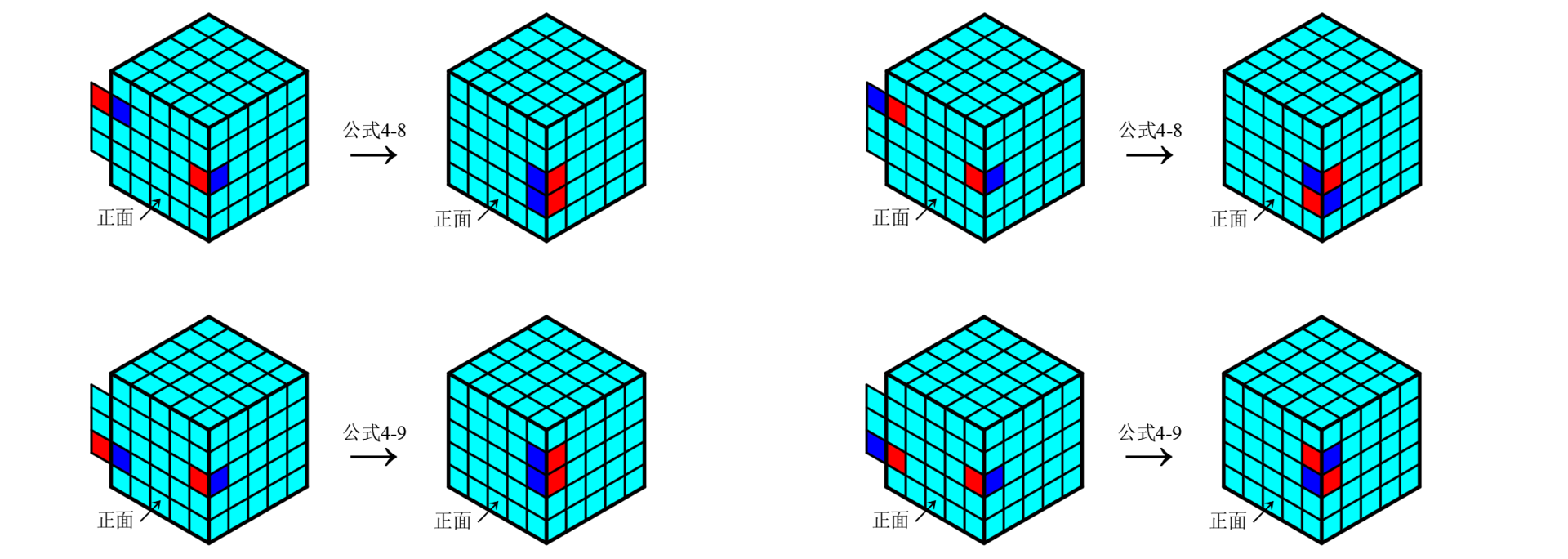
- Adjacent Alignment
As shown in the figure, place the middle edge piece on the right and the edge piece to be paired with it on the left. If the target piece is on the second left layer, apply Formula 4-8 to solve it; if it is on the fourth left layer, apply Formula 4-9.
- Solve the Third Edge Piece
- The third edge piece is near the lower layer
As shown below, position the two pre-paired edge pieces from the previous step at the lower right, and the edge piece to be combined with them at the lower left.
Refer to the relative color positions of all edge pieces in the figure. If the colors of the pre-paired edges are aligned, use Formula 4-10 for solving; if their colors are misaligned, use Formula 4-9.

- The third edge piece is near the upper layer
As shown below, position the two pre-paired edge pieces from the previous step at the upper right, and the edge piece to be combined with them at the upper left.
Refer to the relative color positions of all edge pieces in the figure. If the colors of the pre-paired edges are aligned, use Formula 4-11 for solving; if their colors are misaligned, use Formula 4-8.

- If you need to adjust the colors of edge pieces on the left and right sides, apply Formula 4-12 to flip the two colors of the edge piece.

3. Solve the 3×3 Rubik’s Cube ⚓︎
After solving all center blocks and edge pieces, you may proceed to solve the cube following the standard steps for solving a 3×3 Rubik’s Cube.
All articles on this blog are licensed under CC BY-NC-SA 4.0 unless otherwise stated.
 Wechat
 Alipay
Related Articles
2025-01-27
3×3 Rubik's Cube formula
This article mainly introduces the basic solving method for the 3×3 Rubik's Cube, consisting of three major stages: solving the bottom layer, solving the middle layer and solving the top layer.
2025-02-03
4×4 Rubik's Cube formula
This article mainly introduces the basic solving method for the 4×4 Rubik's Cube, which consists of two main steps: solving center pieces and solving edge pieces. After completing these steps, you can continue solving the cube following the procedures for a 3×3 Rubik's Cube. Two special cases may occur during the solving process that need to be addressed.
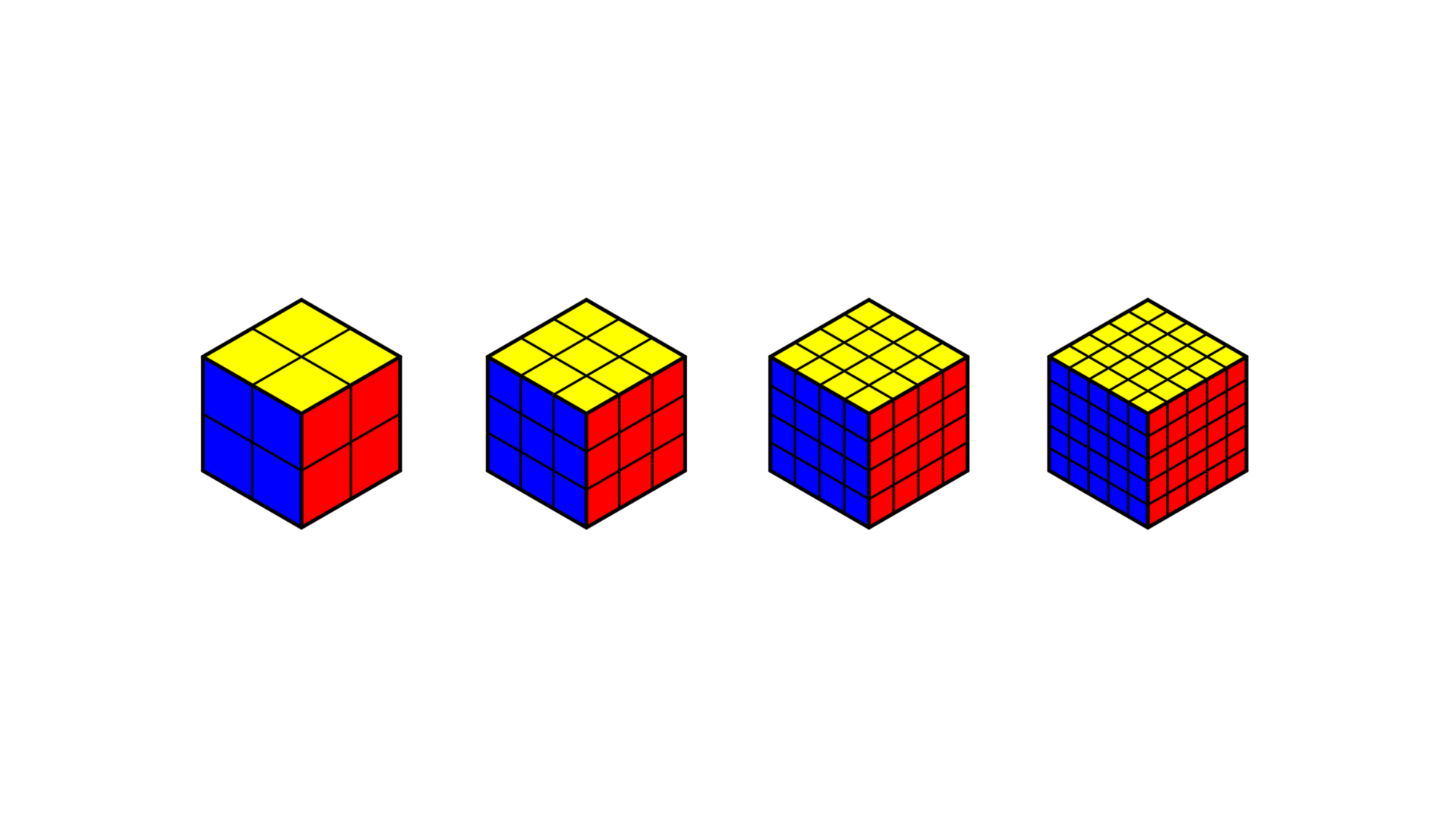
2025-02-07
Rubik's Cube formula
This article includes the basic solving methods of 3x3 Rubik's Cubes, as well as the 2x2, 4x4 and 5x5 Rubik's Cubes.
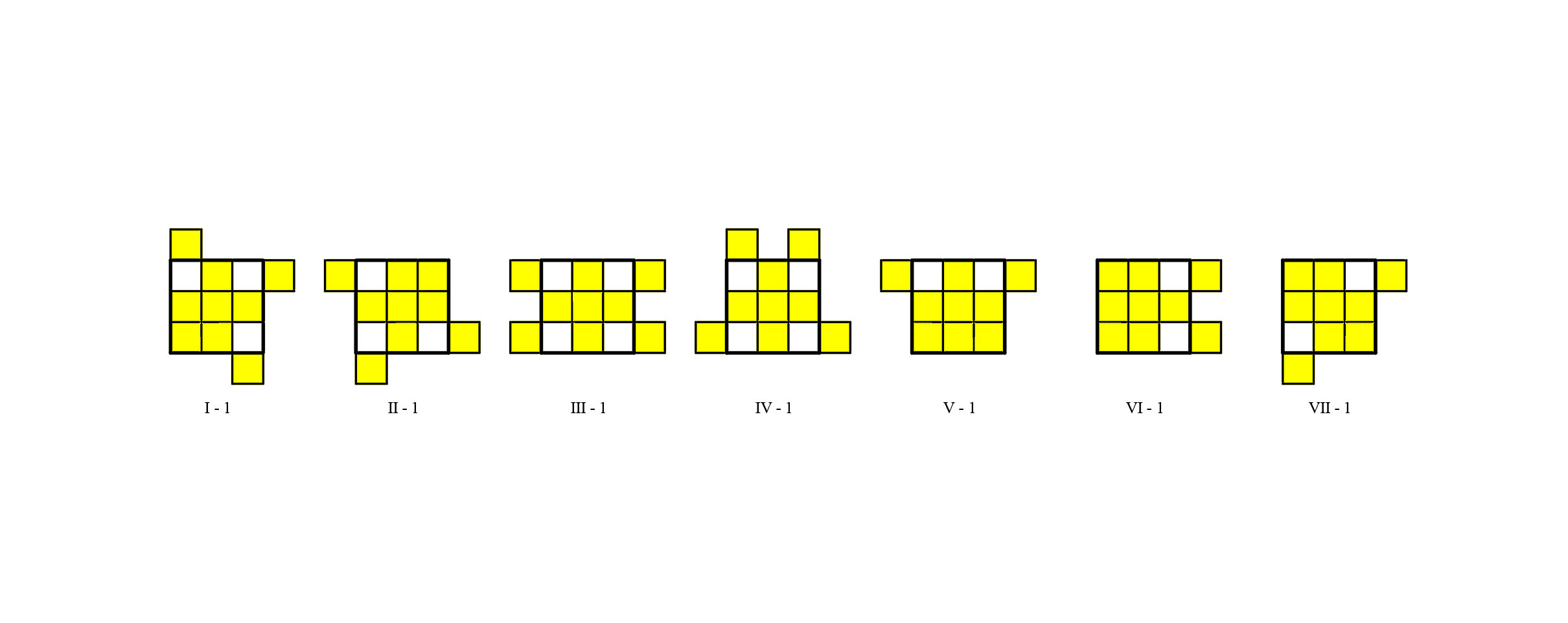
2025-01-30
All States, Transformations and Solving Steps for the Top Face of a 3×3 Rubik’s Cube
This article mainly focuses on all possible states that may appear during the top-face solving stage of a 3×3 Rubik's Cube, along with their transformations and corresponding solving procedures.
2025-02-01
2×2 Rubik's Cube formula
This article mainly covers the basic solving method for the 2×2 Rubik's Cube, which includes two main stages: solving the bottom layer and solving the top layer.
2024-10-24
Hexo Tutorial (5) - Deploy to Cloud Server
Preparation for deploying Hexo to a cloud server: 1. Local Hexo project files that have been completed; 2. Purchased cloud server, such as Tencent Cloud, Alibaba Cloud, etc.; 3. Server system: CentOS or Ubuntu; 4. Server has opened ports: 22 (SSH), 80 (HTTP), 443 (HTTPS, optional); 5. Obtained server public IP, root account password/key; 6. Purchased domain name and registered (unregistered cannot be accessed) (optional); 7. Purchased SSL certificate (can be accessed via HTTPS) (optional).
Comments
Announcement
Wechat Official Account has more content!

Post Series